Thursday, 20 January 2011

Critical Positions on the Media & Popular Culture


Communication Theory Lecture Notes


Human communication is understood in various ways by those who identify with the field. This diversity is the result of communication being a relatively young field of study, composed of a very broad constituency of disciplines. It includes work taken from scholars of Rhetoric, Journalism, Sociology, Psychology, Anthropology, and Semiotics, among others. Cognate areas include biocommunication, which investigates communicative processes within and among non-humans such as bacteria, animals, fungi and plants, and information theory, which provides a mathematical model for measuring communication within and among systems.
Generally, human communication is concerned with the making of meaning and the exchange of understanding. One model of communication considers it from the perspective of transmitting information from one person to another. In fact, many scholars of communication take this as a working definition, and use Lasswell's maxim, "who says what to whom in what channel with what effect," as a means of circumscribing the field of communication theory. Among those who subscribe to the transmission model are those who identify themselves with the communication sciences, and finds its roots in the studies of propaganda and mass media of the early 20th century.

Other commentators claim that a ritual process of communication exists, one not artificially divorcible from a particular historical and social context. This tradition is largely associated with early scholars of symbolic interactionism as well as phenomenologists.
(source: wiki)

Friday, 7 January 2011

Bernd & Hilla Becher

The German born Becher couple concentrated on photographing and documenting the disappearing German industrial architecture. They would exhibit their images of barns, water silos, storage silos, warehouses and other industrial features often side by side so as to invite viewers of their photography to compare details in the architecture. Often the differences were few; but their choice of exhibiting style made these differences all the more apparent.


(mariam goodman gallery)

The couple took a very objective approach to their photographs and their use of a large format camera medium suited this almost scientific documentary style very well. With their chosen medium they were able to eradicate any perspective distortions that a single lens plain camera cannot.

The Bechers are clear lovers of the mid 20th century industrial architecture and through their photography have caused others to consider the structures with the same interest and due diligence. They however give us no access to detail in their images, not even an angles perspective on the structures: They are all photographed from a head on, straightforward point of view.

Although some, like the Bechers may consider the structures that they photographed to be beautiful, non were purpose built to meet those ends. They simply serve a purpose and I can imagine most of the communities that saw them on a day to day basis would happily let them blend into the mundane everyday scenery and wouldn't offer them a second glance. However when they are presented as an art form people seem to feel much more at ease scrutinizing them as an art form rather than structures performing a purpose and built to suit that as such.

As individual images I highly doubt these would work. Alone they would be an image of a boring structure shot in a boring way: However as soon as they are placed together the mind immediately attempts to connect them and in doing so analyses their slight differences and compares their resemblances to one another. As a set they work tremendously well together and this is justified in that their 1976 study of cooling towers sold for the grand price of $150,000 at auction in 2004 (pictured below)


(artnet.com)

I think the Becher's style of photography correlates with Baudrillard's notions of simulation and that they are most probably making a satirical comment on the disappearance of these old German industrial features whilst juxtaposing it with the way in which they exhibit their work which is strongly reminiscent of the mass-reproducible copies of items; an example of which that was taking place at a similar time to their work being exhibited might be Andy Warhol's numerous screen prints, which also play on the modern mass consumerist culture.

Monday, 29 November 2010

Larry Clark - Tulsa


Larry Clark's 1971 photographic book documents his three-year methamphetamine binge with his friends. It is disturbingly honest - many of the images featuring his friends shooting up speed in partial nudity (or completely nude) and their drug induced orgies.

The images are disturbing for their raw reality - Clark has an amazing ability to put the viewer in the room with him and his friends. What is crucial in making none of the images appear at all staged or posed, is that not once in the book do any of the subjects' make eye contact with the camera lens, and us, the viewers looking over Clark's shoulder.

Clark's work relies on the shock factor. However this being said he is giving us an honest insight into this period of his life - which frankly is shocking. He makes no apparent effort to make it any more shocking than it actually is - which makes it all the more disturbing.

It was proclaimed by the Dick Cheverton of the Detroit Press as ‘A devastating portrait of an American tragedy’. He goes on further to accurately gauge the book saying, ‘it is the light – light that comes in cold and New England hard (or Oklahoma vague) into a barren room occupied by an anonymously pregnant woman, beautiful, waiting, a needle in her arm.’ Published with this post is the image; but I think that without visual evidence of that – the description alone is enough to send shivers down one’s spine.

Larry Clark’s images are unapologetic, unorthodox, completely uncensored and chilling to the core. All this being said he is my favourite documentary photographer, my favourite filmmaker, and a man who I see as an all-round revolutionary. He makes it near impossible for anyone to shock the public with their work in quite the same way he has – and go down a legend whilst doing it.

Friday, 19 November 2010

Week III: Research historical and contemporary documentary photography, compare and contrast

Martin Parr serves for an excellent response to most of these questions. Having been a serious photographer since 1975 he has nearly half a century of first hand experience of the photography world, a quality for which there is no substitute. He also attempts to keep his equipment, style and subject matter contemporary throughout the years; and it must be for this reason amongst others that he declares himself as a “post modern photographer” [Parr by Parr, Quentin Bajac & Martin Parr].

Throughout his photographic years Parr has been a slave to manual cameras. Although the battle between manual and digital camera-using photographers has waged for years it’s safe to say that to this day any photographer practising on film and labouring over their work for hours on end in the darkroom will be considered as more of an artist, and as a product for their work to be considered art.

It was only in the 1970s that documentary photography became widely accepted as a valid art form. Until this point photographers were shunned from exhibiting; photography was more of a job to serve a purpose rather than the thoughtful, often purposeless ‘art forms’ we see today. Documentary photography these days is exhibited all across the world in galleries, magazines, books etc.

Documentary photographers have a duty to their subjects to be truthful to reality, but as photographers tried to add their own interpretive and artful dimension to what they see around them; it was only a matter of time before discrepancies began to arise concerning the photographer’s fidelity towards his subject.

In the words of Jerry Thompson; “Whether their [the photographer’s] intent is descriptive or expressive – truth depends on the vision and mastery of the photographer.”

Sunday, 14 November 2010

Brassaï

1

(image courtesy of joseflebovicgallery.com)
2
(image courtesy of mudwerks.tumblr.com)
3
(image courtesy of picsicio.us)

Brassaï is my most little known of the three photographers listed: So if only for my benefit a short bio is necessary. "Brassai was the pseudonym of Gyula Halász (1899-1984), a Parisian photographer. Gyula Halász was born on September 9, 1899, in Brassó (Braăov), then part of Hungary but today it belongs to Romania. Gyula Halász's job and his love of the city, whose streets he often wandered late at night, led to photography. He later wrote that photography allowed him to seize the Paris night and the beauty of the streets and gardens, in rain and mist. Using the name of his birthplace, Gyula Halász went by the pseudonym "Brassaï," which means "from Brasso." As Brassaï, he captured the essence of the city in his photographs, publishing his first book of photographs in 1933 titled Paris after Dark. His efforts met with great success, resulting in him being called "the eye of Paris" in an essay by his friend Henry Miller. In addition to photos of the seedier side of Paris, he also provided scenes from the life of the city's high society, its intellectuals, its ballet, and the grand operas. He photographed many of his great artist friends, including Salvador Dalí, Pablo Picasso, Henri Matisse, Alberto Giacometti, plus many of the prominent writers of his time such as Jean Genet, Henri Michaux and others."
(biography exert courtesy of www.biographybase.com)

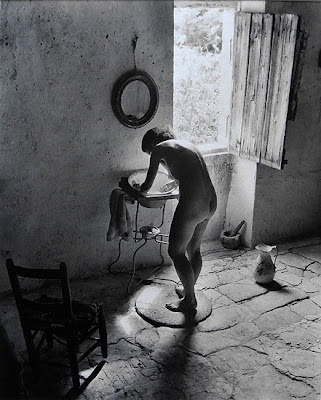
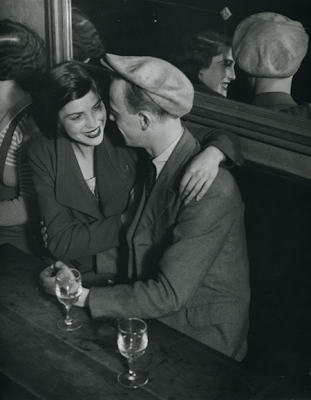
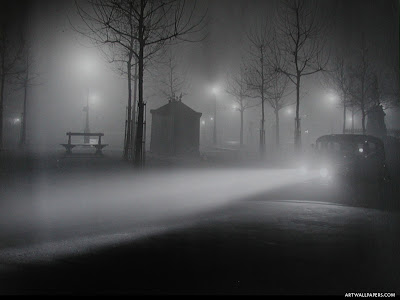
I have chosen my three Brassaï images very carefully, so I can illustrate the similarities Brassaï and Cartier-Bresson share, both of them photographing similar things at a similar point in the development of documentary photography. I also plan to illustrate the influences Clark might have drawn from Brassaï, or the similarities that both works display. Seeing as Clark's peak of his photographic career took place towards the end of both Brassaï and Cartier-Bresson's careers it is highly likely that Clark had been exposed to their work and more likely than not will have drawn influence from them.

1. This image has a very strong voyeuristic element - by way of the nude woman going about washing - and what crucially makes it voyeuristic her turned back and lack of eye contact with the viewer. Its a fairly controversial scene and would have been more so at its time of shooting. The mass public has become vastly desensitized by the nonchalant media treatment of extreme or shocking images hence making this image of a nude woman washing - apparently oblivious to the camera's presence - all the more tame in today's day and age. It is for reasons such as these that it is no surprise to me that this precedes Clark's Tulsa by twenty or thirty years; because as communications strengthen and the public has greater and easier access to more and more media we begin to see the same things more and more, and so it takes more and more to shock us. This makes it quite easy to date photography that deals with explicit content or subjects that cause a stir because the more graphic it is - chances are it's going to have been shot more recently.

2. This style of social observational documentary is very popular, and due to the sheer amount of people that have been attempting to recreate these kind of images (and although this is a classic - perfectly framed, interesting use of the reflection, and reminiscent of a more romantic photographic version of Degas' Absinthe Drinker, 1877. Unfortunately due to the mass attempted reproduction of images of this style it loses some of the charm I can imagine it would have had in the mid 20th century.

3. The final Brassaï image is the one that I feel is most evocative of his style, and most comparable to Cartier-Bresson (out of the images displayed). Both photographers were shooting Paris scenes and attempting to depict it in new and innovative ways. In this case, and many others Brassaï has pulled himself up levels above the rest with his stunning night photography. Perfectly exposed, using the light from cars and street lamps to illuminate the evening's mist he creates an eerie scene that could quite easily be a still from an early black and white horror film.

Larry Clarke


(image courtesy of vingtparismagazine.com)


(image courtesy of odaaniepce.wordpress.com)


(image courtesy of www.catch-fire.com)

I have chosen to discuss Clark's work in a slightly different way to that in which Cartier Bresson was treated. Admittedly my knowledge of Clark's work is tenfold greater than that of Cartier Bresson. Being a fan of first his photography; but now an avid fan of all of his films I feel our connection as artist and viewer has grown stronger still.

Unlike many creators of both the moving and the still image Clark makes no attempt to erect a facade between his viewers and his message. His early photography (all of the above images are taken from his 1971 book 'Tulsa') seems to be the foundation of his films; and they're all from personal experience which makes his tales all the more relatable.

Tulsa begins with a short introduction from Clark: "I was born in Tulsa, Oklahoma in 1943. When I was sixteen I started shooting amphetamine. I shot amphetamine with my friends everyday for three years and then I left town but I've gone back through the years. Once the needle goes in it never comes out."

A big part of Clark's work his unique ability to provide shock factor. The three included images illustrate three very prominent sides of Clark's ferociously honest depictions of kids in the 'burbs.

We see a young man posing with a gun in the most disturbingly nonchalant way, we have two young women making love in a bath tub and one of Clark's speed-freak friend's shooting up in the bath. Even when Clark's images appear posed, or that he had offered some form of direction to his subjects there is still an overriding voyeuristic element. Clark honestly offers his unadulterated documentary of a middle class teenage drug culture that was unheard of at the time of photography (early 1960s) and publication (1971) and he forced american society to view and accept that this was going on right beneath the public's noses.